Anyone who has spent time in a formulation lab knows the small frustrations that decide whether a pesticide actually performs in the field. A herbicide that beads off a waxy leaf. An emulsion that separates in hard borewell water. A spray tank that foams up halfway through the morning run. These aren’t theoretical problems. They cost yield, they cost reputation, and they push manufacturers to look harder at the surfactant chemistry sitting underneath their active ingredients.
That is one of the bigger reasons phosphate ester surfactants have moved from a niche choice to a serious workhorse in modern agrochemical formulations.
What Are Phosphate Ester Surfactants?
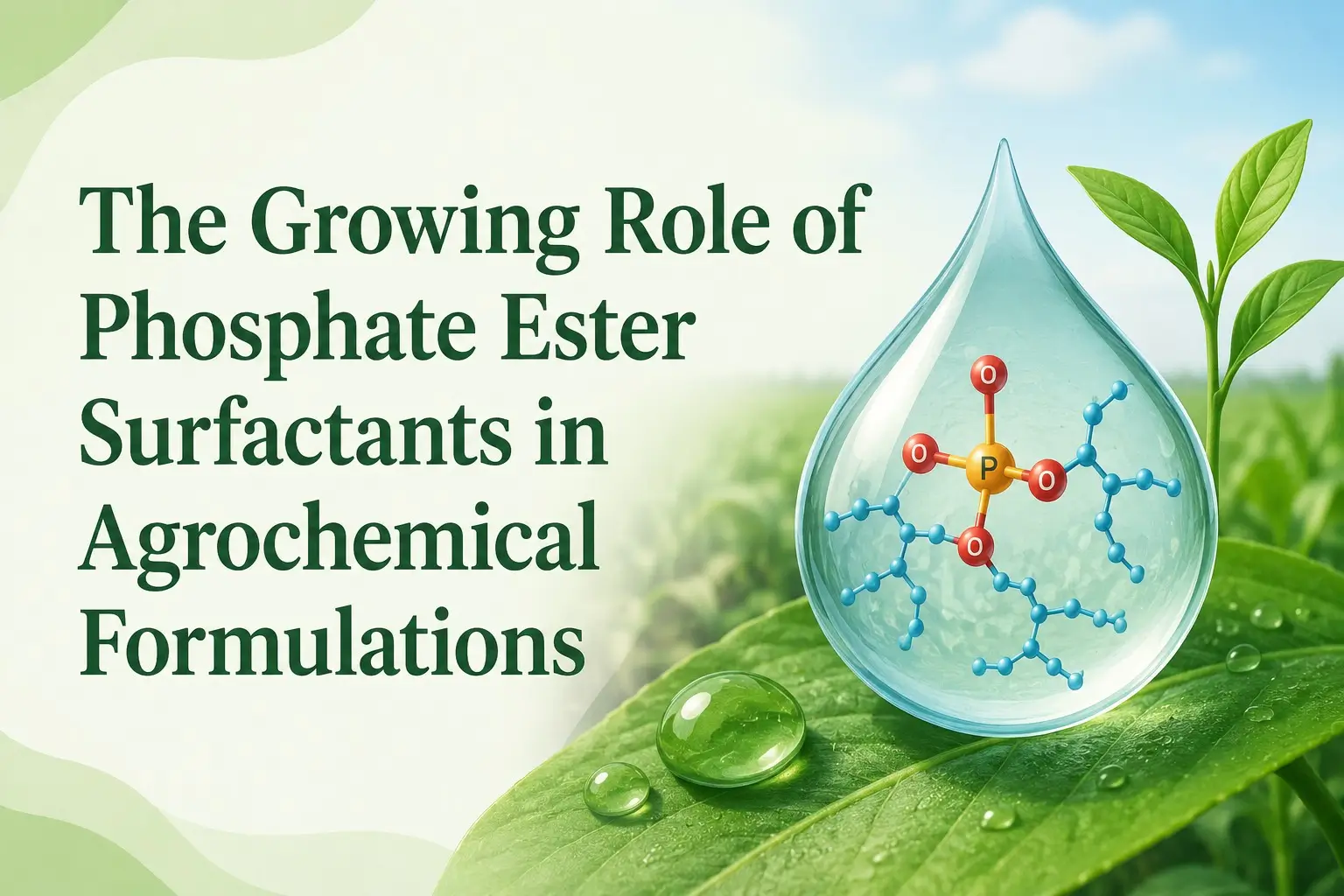
In simple terms, phosphate esters are anionic surfactants built by reacting an alcohol or alcohol ethoxylate with phosphoric acid or P₂O₅. The result is a molecule with a hydrophobic tail (often C8–C18, sometimes with EO/PO units) and a phosphate head group that carries a negative charge once neutralized.
You’ll typically see them supplied as mono- and di-ester mixtures, either in acid form or neutralized with potassium, sodium, triethanolamine, or ammonia depending on the end use. That flexibility is half the appeal: change the EO chain length, the alcohol backbone, or the neutralizing base, and you can dial in solubility, hydrolytic stability, and compatibility with very different actives.
Where Are They Used in Agrochemicals?
Phosphate ester surfactants now show up across most major formulation types:
- Emulsifiable concentrates (EC): as co-emulsifiers paired with nonionics, especially for difficult oils and pyrethroids.
- Suspension concentrates (SC) and SE formulations: as dispersants that hold particles stable under temperature swings.
- Soluble liquids (SL) and herbicide adjuvants: notably with glyphosate, glufosinate, and 2,4-D salts, where they help wetting and uptake.
- Tank-mix and built-in adjuvants: improving spray retention on hydrophobic leaf surfaces like cabbage, soybean, and weed grasses.
- Wettable powders and water-dispersible granules: as wetting and rewetting agents.
Beyond crop protection, the same chemistry shows up in industries like personal care, metalworking fluids, textile processing, and oilfield applications — which is why bulk producers can often supply consistent grades across multiple verticals.
Why Is Demand for Phosphate Ester Surfactants Growing?
A few shifts are driving the uptick, and they’re not all about chemistry.
First, regulatory pressure on legacy adjuvants has reshaped the market. The phase-down of alkylphenol ethoxylates (APEs) in Europe and parts of Asia, along with tighter scrutiny of tallow amine ethoxylates in glyphosate formulations, has pushed formulators to find alternatives. Phosphate esters, particularly those based on linear alcohols, offer a cleaner toxicological and ecotoxicological profile and generally play well with newer regulatory frameworks.
Second, field conditions are getting tougher. Hard water with high calcium and magnesium loads is normal in large parts of India, Australia, and the Middle East. Many traditional nonionics struggle here. Phosphate esters, especially the potassium-neutralized grades, tolerate hard water and high electrolyte loads far better, which translates to fewer field failures and fewer customer complaints.
Third, formulators are under cost and performance pressure at the same time. A surfactant that doubles as an emulsifier, a wetting agent, and a hydrotrope reduces ingredient count. That matters when registration costs and SKU complexity are climbing.
Key Benefits for Manufacturers and Bulk Buyers
For procurement teams and formulation chemists evaluating phosphate ester surfactants in volume, the practical advantages are fairly concrete:
- Hydrolytic stability across a broad pH range (roughly 3–11), which is critical for SC and SL formulations.
- Low foaming behavior compared with many sulfates and sulfonates, easing field application.
- Compatibility with anionic and nonionic systems, allowing simpler blend design.
- Customizable mono/di ester ratios, giving control over solubility and emulsification power.
- Scalable manufacturing with consistent acid value, free phosphate, and color batch to batch.
- Cost efficiency at volume, especially when sourced as concentrates that buyers can neutralize in-house.
For a bulk buyer, the last point is worth repeating. Buying the acid form and finishing it at the plant gives flexibility on the cation and removes shipping water from the equation.
How Do You Choose the Right Phosphate Ester Surfactant Supplier?
This is where guest articles often get vague. So let’s be specific. When evaluating an industrial grade phosphate ester manufacturer or bulk supplier, the questions worth asking are:
- Can they share a typical analysis showing acid value, free phosphoric acid, water content, and color?
- What is their control over the mono- to di-ester ratio, and can they adjust it on request?
- Do they offer both acid form and pre-neutralized grades (K, Na, TEA, NH₄)?
- Is the feedstock (fatty alcohol, ethoxylate) traceable, and is it APE-free?
- Do they have REACH registration, EPA inert listing, or relevant regional approvals for export markets?
- What is their minimum batch size, and how do lead times look during peak agrochemical season (typically Q1 and Q3 in the northern hemisphere)?
A good supplier answers these without hesitation. A great one sends you a sample, a technical data sheet, and a formulation suggestion in the same week.
See also: Digital Transformation in Healthcare: Revolutionizing Patient Care and Operational Efficiency
Global Demand and Supply Outlook
Geographically, the agrochemical surfactant story is interesting right now. India has emerged as a major manufacturing base for both technicals and formulation intermediates, exporting phosphate ester surfactants and emulsifier blends to Brazil, the United States, Southeast Asia, and increasingly to Europe. Brazil remains the world’s largest agrochemical consumer, with steady demand for glyphosate and herbicide adjuvants. The US market continues to grow on the back of row-crop herbicide use, while Europe drives the regulatory direction the rest of the world tends to follow.
China is still a significant producer, but tighter environmental enforcement and energy controls have pushed buyers to diversify, and India has captured a meaningful share of that shift.
For exporters and bulk buyers, this means a more competitive landscape — but also more reliable second-source options than the industry had even five years ago.
Final Thoughts
Phosphate ester surfactants aren’t new chemistry. What’s new is how central they’ve become to building modern, regulation-ready agrochemical formulations that actually perform in the field. For manufacturers, formulators, and bulk buyers planning the next product cycle, it’s worth taking a closer look at where these surfactants fit in your current portfolio — and whether your supplier is keeping up with where the market is heading.
If you’re sourcing in volume, a short technical conversation with a specialty surfactant manufacturer is usually time well spent. The right partner won’t just ship a drum. They’ll help you formulate.